
Many business owners reach a point where they feel stuck between two realities.
On one hand, the bookkeeping is getting done. Transactions are categorized, bank accounts are reconciled, and financial statements are being produced.
On the other hand, questions keep popping up that the bookkeeping doesn’t answer.
Why is cash lower than expected?
Why are margins shrinking even though sales are growing?
Why did we miss our profit target?
Which customers, jobs, or services are driving profitability?
At that point, the issue usually isn’t bad bookkeeping. The issue is that the business has reached a stage where it needs greater financial visibility.
Bookkeeping, controllership, and CFO services each serve a different purpose. Understanding the difference can help business owners identify what type of financial support they actually need.
Bookkeeping is the foundation. Its primary job is to accurately record financial activity and produce reliable financial statements. Without good bookkeeping, everything else becomes difficult. Bookkeeping answers the question, “What happened?” It tells you how much revenue came in, what expenses were incurred, and where the business stands financially.
For newer businesses and smaller organizations, that may be enough. But as a company grows, the questions often become more complex.
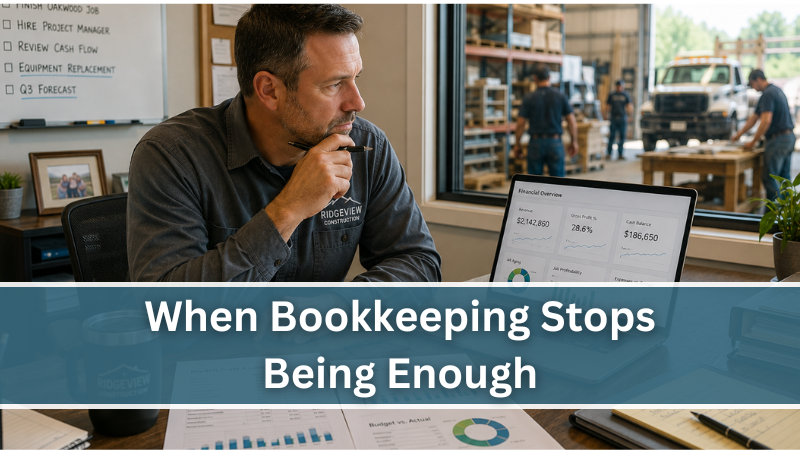
Imagine a construction company that has grown from $750,000 to $3 million in annual revenue. The books are accurate and delivered on time. Yet the owner finds himself frustrated. Cash flow seems unpredictable. Some projects appear profitable while others don’t. Expenses fluctuate from month to month. Despite having financial statements, he still feels like he’s making important decisions with incomplete information.
This is where controllership begins to play a role.
While bookkeeping focuses on recording transactions, controllership focuses on helping owners understand what those transactions mean. A controller looks for patterns, identifies issues, monitors key performance indicators, tracks budgets and forecasts, analyzes variances, and helps establish financial processes that create consistency and accountability.
Controllership often includes things like cash flow projections, project tracking, dashboard reporting, accounts receivable monitoring, budget oversight, and regular financial review meetings. The goal is not simply to produce numbers. The goal is to create visibility into what is happening inside the business and where management’s attention should be focused.
One mistake we see occasionally is the assumption that financial statements alone create insight. In reality, most business owners don’t struggle because they lack reports. They struggle because they lack context. A profit-and-loss statement can tell you that profit declined. It doesn’t necessarily explain why.
A controller helps bridge that gap.
Eventually, some businesses need something even more strategic.
That is where CFO services enter the picture.
A simple way to think about the distinction is this:
A controller asks, “What happened financially?” A CFO asks, “What should we do financially?”
The CFO’s role is more forward-looking and decision-oriented. CFO services may involve evaluating growth opportunities, helping determine hiring plans, assessing financing options, modeling expansion scenarios, supporting acquisitions, or advising ownership on major strategic decisions.
Not every business needs a CFO. In fact, many small businesses are not yet at that stage.
What we often see, however, is businesses that have clearly outgrown basic bookkeeping but are not yet ready for full CFO support. They need better forecasting. Better reporting. Better visibility into cash flow and performance. They need someone helping them connect the dots between the numbers and the day-to-day operation of the business.
In other words, they need a stronger financial management system.
Understanding where your business sits on this spectrum can be helpful. The financial needs of a $500,000 company are very different from those of a $5 million company. As businesses grow, the questions become more sophisticated, and the financial support needed to answer those questions often evolves as well.
The businesses that consistently make better decisions are rarely the ones with the most reports. They’re the ones with the clearest understanding of what the numbers are telling them and the discipline to act on that information.
If you’re feeling confused by your numbers or need someone to guild you as you make financial decisions, we’re ready to help. We offer accounting and advisory services so you can enjoy your business again and get back to what you do best. Contact us at help@sbsaccountants.com or 770-745-4283.